Short answer
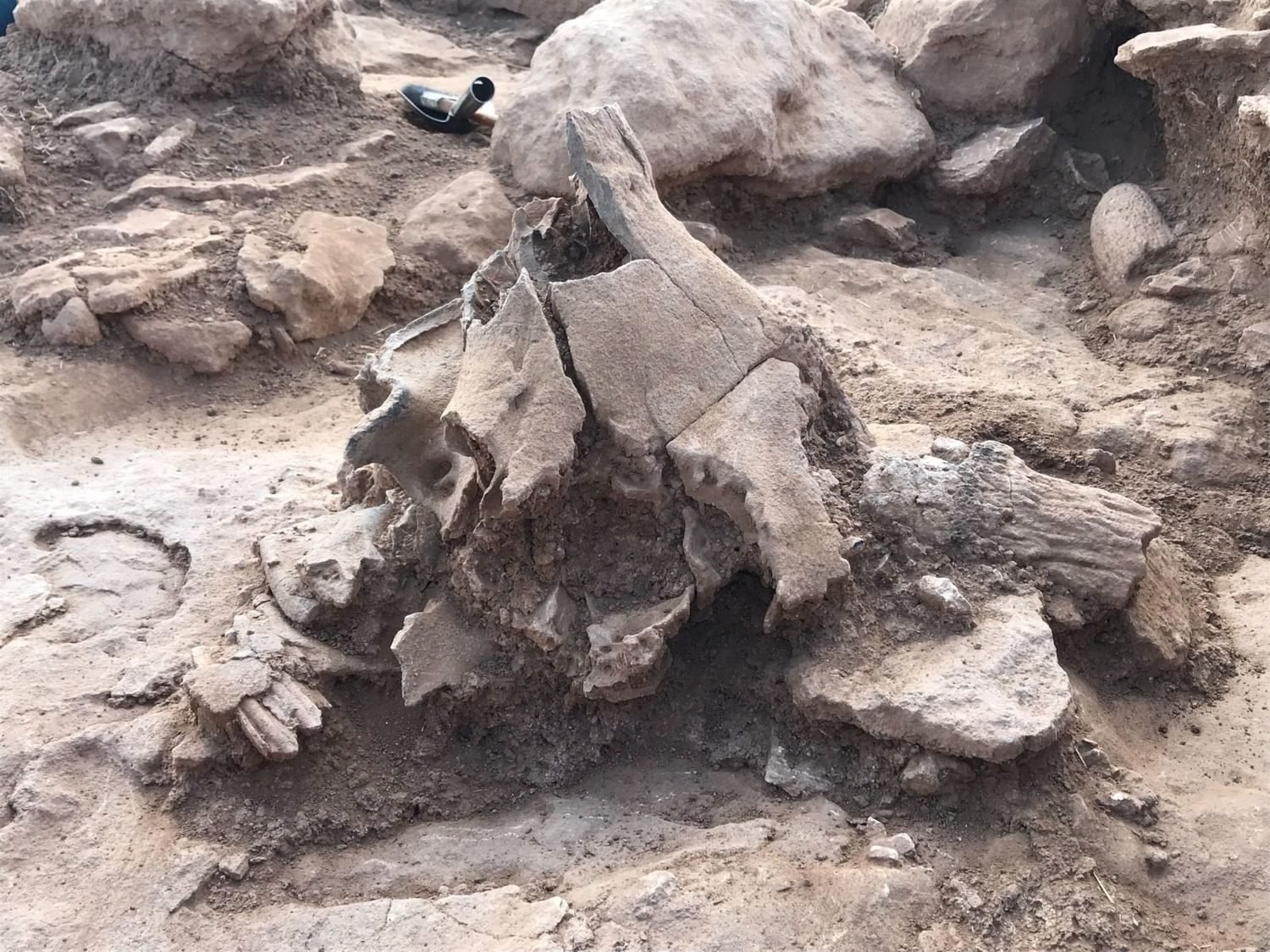
They are deliberate deposits of selected animal skulls placed in and around Çakmaktepe's buildings — most dramatically, more than thirty burnt gazelle skulls found in 2025 outside Special Building 15.
The 2025 deposit lay in front of the building's exterior wall across roughly 10 by 3 metres, the gazelle horns intact, with five wild sheep heads among them; earlier seasons had found different head deposits inside a building. The repetition across buildings and seasons makes it look like a custom, but what it means — offering, closure, display or feasting residue — is not established, and the placement plan and faunal analysis remain unpublished.
The 2025 deposit
The most substantial find comes from the 2025 season. More than thirty burnt gazelle skulls, together with five wild sheep heads, were recorded outside Special Building 15 — in front of its exterior wall, across an area of roughly 10 by 3 metres.
The gazelle horns were reported intact, and the placement appears deliberate.
This is not a refuse scatter. It is a defined strip of ground along the outside of a specific wall, containing selected body parts of selected species, burned.
It happened more than once
Earlier seasons at Çakmaktepe reported a different set of animal-head deposits inside a special building, placed along the wall bases — including cattle, sheep and equid skulls.
So the practice appears in more than one building, in more than one position, with more than one range of species. Interior and exterior. Different animals.
That repetition is the strongest part of the evidence. A single deposit could be circumstance. A practice recurring across buildings and seasons is a custom.
Why heads, and why burnt
The head is a choice. Whoever made these deposits selected skulls specifically. The rest of the animal went somewhere else. Heads carry the horns, the face and the identity of the animal — the parts by which a species is recognised.
Burning is a second choice. It transforms, and it is irreversible. Whether the burning happened where the skulls were found or elsewhere is not yet published, and the answer would matter: fire in place suggests an event at that spot, fire elsewhere suggests material brought and deposited.
Placement is a third. Along a wall base inside; along the exterior wall outside. Both are edges of a building. These deposits mark boundaries.
What it might be
An offering made at the entrance or perimeter of a special building.
Closure — a ritual performed when a building went out of use, which is a documented concern in this region and connects to the wider debate about how these structures were ended.
Display, asserting what the building was or what its community claimed.
Feasting residue, formally deposited — the heads kept and placed after the meat was consumed.
Accumulation over repeated occasions rather than a single act.
The evidence does not currently separate these, and more than one may be true of different deposits at the site.
It is not unusual for the period
Comparable practices appear at other sites of this broad horizon. At Hallan Çemi, an aurochs skull was found apparently placed against a wall facing a building's entrance, and another house contained three male sheep skulls with red deer antlers.
So the placing of animal skulls in and around buildings is a recognisable regional behaviour rather than a Çakmaktepe peculiarity.
And it sits alongside what these communities did with human heads — kept, modified, gathered, positioned. The materials and contexts differ, and no one has demonstrated the practices are versions of one another. But the recurring logic is hard to miss: the head is the part that gets selected, treated and placed.
What has not been published
The arrangement within the 10 by 3 metre area, and whether it has internal structure.
The taphonomy — where the burning occurred, and whether the deposit formed at once or over time.
The full faunal table with confirmed counts and identifications.
How the deposit relates to Special Building 15's own sequence: its use, or its abandonment.
Until those appear, this is a concrete and genuinely unusual body of evidence whose meaning is open — which is a more interesting position than a confident answer would be.
Common questions
What are the Çakmaktepe burnt animal heads?
Deposits of selected animal skulls placed in and around special buildings. The largest, reported in 2025, is more than thirty burnt gazelle skulls and five wild sheep heads outside Special Building 15.
How many gazelle skulls were found?
More than thirty, with five wild sheep heads, across an area of roughly 10 by 3 metres in front of the exterior wall of Special Building 15.
Were they placed deliberately?
The placement is reported as deliberate — a defined strip along a specific wall containing selected body parts of selected species, rather than a general refuse scatter.
Has this happened more than once at Çakmaktepe?
Yes. Earlier seasons reported animal-head deposits inside a special building along the wall bases, including cattle, sheep and equid skulls. The repetition suggests a custom rather than a one-off.
What do the deposits mean?
Not established. Offering, closure of a building, display, formally deposited feasting residue, or accumulation over repeated occasions are all plausible, and more than one may apply.
Do other sites have animal skull deposits?
Yes. At Hallan Çemi an aurochs skull was found apparently placed by a wall facing a building's entrance, and another house held three male sheep skulls with red deer antlers.
Sources & further reading4 references
- Şahin, F. et al. (2023). Çakmaktepe Kazısı 2022 Yılı Kazı Çalışmaları. Kazı Sonuçları Toplantısı (Turkish Ministry of Culture and Tourism excavation reports).
- Clare, L. (2020). Göbekli Tepe, Turkey. A brief summary of research at a new World Heritage Site (2015–2019). e-Forschungsberichte des Deutschen Archäologischen Instituts 2020(2): 81–88.
- The Tepe Telegrams (official research blog of the Göbekli Tepe Project, DAI). The Tepe Telegrams. Deutsches Archäologisches Institut. link Accessible, authoritative running commentary from the excavation team.
- Rosenberg, M., Nesbitt, R. M., Redding, R. W. & Strasser, T. F. (1995). Hallan Çemi Tepesi: Some preliminary observations concerning early Neolithic subsistence behaviors in eastern Anatolia. Anatolica 21: 1–12.
Full bibliography: the Taş Tepeler reference library →