Short answer
Çakmaktepe has produced the material of early Neolithic daily life rather than monumental pillars: rock-cut houses and communal buildings, mortars and grinding stones for processing wild plants, chipped-stone tools, and deliberate deposits of burnt animal heads.
The finds fall into a few strands worth taking in turn — the buildings, the food-processing equipment, and the animal-head deposits associated with Special Building 15. Together they place Çakmaktepe among the earlier, more domestic chapters of the Taş Tepeler world, though its detailed chronology and full building plans are still being established.
The buildings
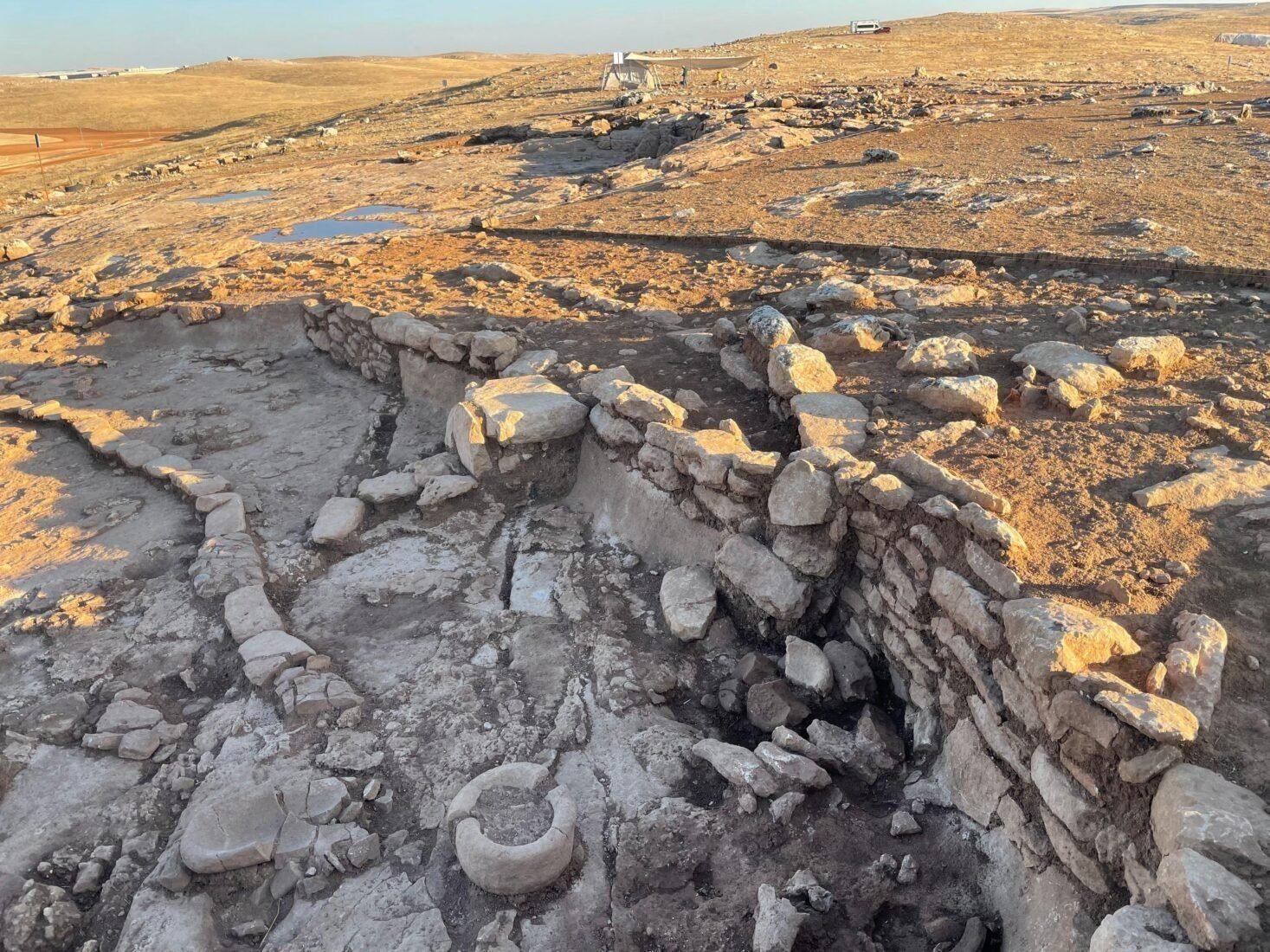
The most basic finds at Çakmaktepe are the buildings themselves. Excavation has exposed around fifty circular, single-room houses cut straight into the bedrock, roughly 3.5 to 6 m across, together with larger rock-cut buildings up to about 16 m across with open interiors, benches and postholes.
These were carved rather than raised — a different architectural tradition from the monumental enclosures nearby, and a sign of a genuine settlement rather than a sanctuary.
Mortars and grinding stones
The house floors carry mortars cut into the rock and portable grinding stones — the heavy equipment of processing wild plant food, especially cereals.
In quantity, and in this early context, they point to intensive plant-processing before farming: the practical groundwork on which settled life, and eventually agriculture, was built.
The burnt animal-head deposits
The most distinctive finds are deliberate deposits of selected animal skulls placed in and around buildings. In 2025, more than thirty burnt gazelle skulls, with five wild sheep heads, were recorded outside a special building; earlier seasons found different head deposits inside another.
These look deliberate rather than accidental — a defined placement of selected, burned body parts. What they mean is not yet established, and is best read as a hypothesis rather than a settled story.
Special Building 15
The 2025 gazelle-skull deposit was found against the exterior wall of a structure the excavators call Special Building 15 — a communal, non-domestic building.
As a building it is still largely unpublished; it is known chiefly through what was placed outside it. The deposit and the building are best treated as two separate topics.
What is still uncertain
Çakmaktepe's detailed chronology and the full plans of its buildings are still being established by ongoing excavation. Its precise dates, the exact nature of its communal structures, and how the burnt-head deposits were made are open questions.
The site is a genuine work in progress — which is why its finds are best described specifically and cautiously, rather than folded into a finished narrative. Most of what circulates in English is season reporting rather than final publication.
Common questions
What was found at Çakmaktepe?
Rock-cut houses and larger communal buildings, mortars and grinding stones for processing plant food, chipped-stone tools, and deliberate deposits of burnt animal heads — the material of early Neolithic daily life rather than monumental pillars.
Are there monumental T-pillars at Çakmaktepe?
No. Unlike Göbekli Tepe or Karahan Tepe, Çakmaktepe is a settlement of rock-cut houses and communal buildings, not a site of monumental carved enclosures.
Is Çakmaktepe as old as Göbekli Tepe?
It belongs to the same broad early Pre-Pottery Neolithic horizon, and is often called older, but the reported ranges overlap and its precise dating relative to Göbekli's enclosures is still being established. No radiocarbon series has been published in English.
Sources & further reading4 references
- Şahin, F. et al. (2023). Çakmaktepe Kazısı 2022 Yılı Kazı Çalışmaları. Kazı Sonuçları Toplantısı (Turkish Ministry of Culture and Tourism excavation reports).
- Clare, L. (2020). Göbekli Tepe, Turkey. A brief summary of research at a new World Heritage Site (2015–2019). e-Forschungsberichte des Deutschen Archäologischen Instituts 2020(2): 81–88.
- Karul, N. (2021). Buried Buildings at Pre-Pottery Neolithic Karahantepe. Türk Arkeoloji ve Etnografya Dergisi 82: 19–29. link
- Şahin, F. & Massa, M. (2025). Mass-hunting in South-west Asia at the dawn of sedentism: new evidence from Şanlıurfa, south-east Türkiye. Antiquity.
Full bibliography: the Taş Tepeler reference library →