Short answer
No — Göbekli Tepe is not the literal Garden of Eden, and no find at the site names Eden or any scripture. The comparison is a modern metaphor for a real turning point: the end of the foraging world and the start of farming and toil.
The site sits in the uplands of the Fertile Crescent, near where wild wheat was domesticated soon after, and its own excavator Klaus Schmidt noted the poetic resonance with Eden. But treating the hill as the actual Eden is faith or fancy, not archaeology — and we keep the two apart.
Where the idea comes from
You will see Göbekli Tepe called the Garden of Eden all over the internet, and the idea did not begin as clickbait — it started, in a careful form, with the site's own excavator. Klaus Schmidt noted the resonance: here, in the uplands of the Fertile Crescent, was a lush foraging world that people gradually gave up for the labour of farming.
The overlap people reach for is thematic. The Book of Genesis describes an easy paradise, four rivers, and an expulsion into a life of toil — 'by the sweat of your brow.' Göbekli Tepe sits right at the moment when a comparable change actually happened.
What the site actually is
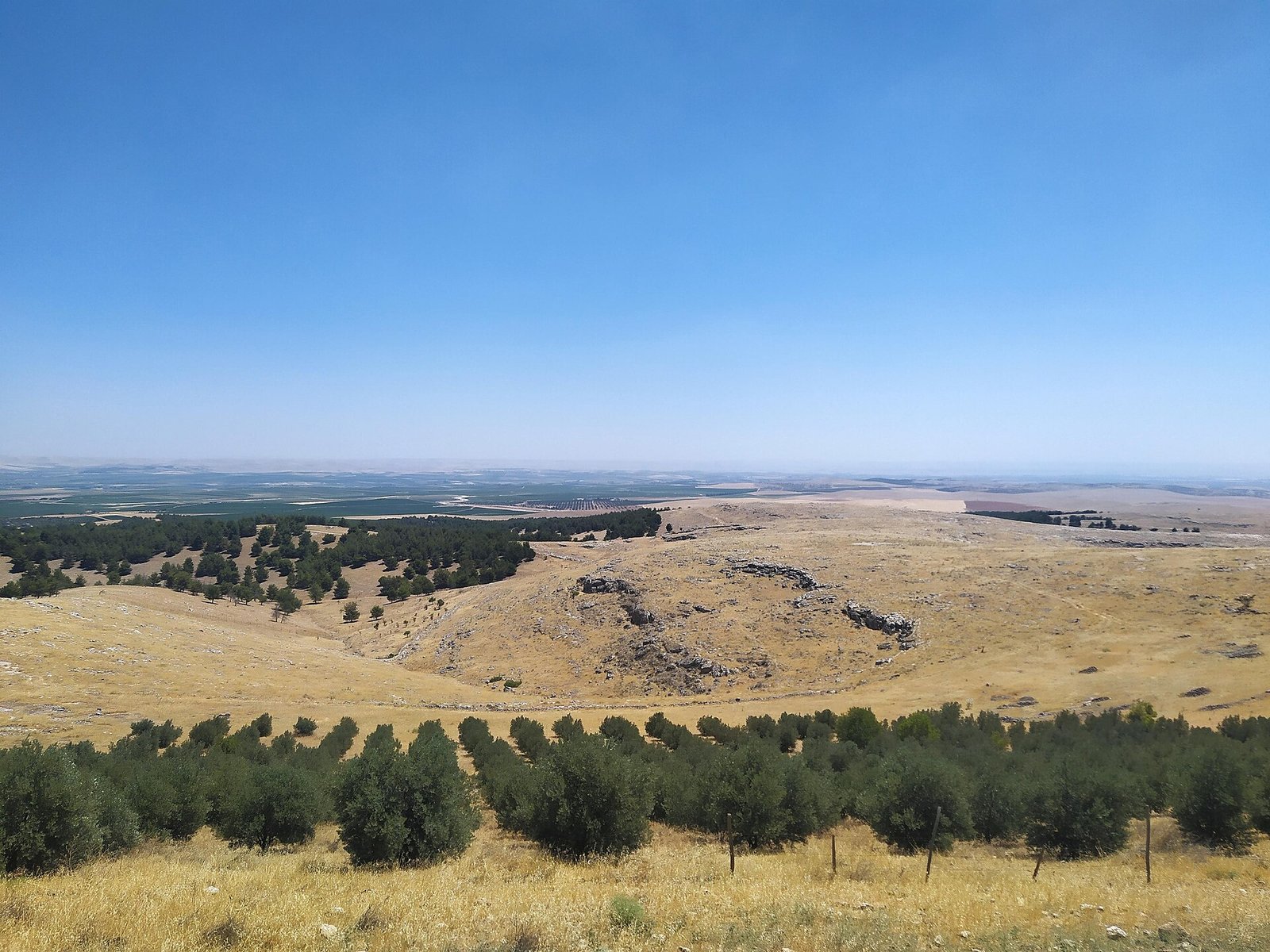
Göbekli Tepe is a Pre-Pottery Neolithic monument in the hills near Şanlıurfa, raised by hunter-gatherers around 9500 BCE. It lies within the broad arc of the Fertile Crescent, not far from the Karacadağ region where wild einkorn wheat was domesticated soon afterwards — one of the birthplaces of farming.
That geography is the whole basis of the comparison. But it is worth being blunt about the limit: no text, inscription, or find at Göbekli Tepe names Eden, references any scripture, or connects the site to the Bible. The link is one modern readers draw; it is not written into the stones.
A metaphor that fits a real change
Read as metaphor, the Eden comparison is genuinely useful, because something real did end in these centuries. The long age in which people lived by gathering and hunting gave way to fields, herds, ownership and work — a transition Göbekli Tepe and its neighbours sit right on top of.
The memory of a lost, easier world, given up for toil, is exactly the kind of experience that can echo down into later myth. That is what the Eden story dramatises: paradise, then the sweat of the field. As a lens for feeling that change, the comparison earns its keep.
Why the idea sticks
Göbekli Tepe lands on a genuine hinge in the human story — the end of foraging and the start of farming — and that is the same hinge the Eden story turns on. The overlap is thematic and powerful, which is why the comparison spreads so easily.
It also flatters our sense of significance: the wish that the oldest monument on Earth should be the place, the literal paradise, is strong. But a metaphor that resonates is not the same as a claim that can be checked.
The four rivers, and the real geography
People who want a literal Eden often reach for Genesis's four rivers — the Tigris, the Euphrates, and two others — and note that the Tigris and Euphrates both rise in the highlands of eastern Türkiye, not far from Şanlıurfa. That is true, and it is part of why the region has drawn Eden-hunters for centuries.
But 'near the headwaters of two of the four rivers' is a long way from 'this hill was the garden.' The other two rivers of Genesis have never been securely identified, the text is describing a mythic landscape rather than mapping one, and the same rough geography could point at dozens of places. The rivers make the region resonant; they do not pin the story to Göbekli Tepe.
Şanlıurfa, city of the prophets
The Eden idea also travels in the company of a real local tradition. Şanlıurfa — ancient Edessa — has long been called the 'city of the prophets,' and is tied by Islamic and local tradition to Abraham, with a cave in the city shown as his birthplace and a sacred carp pool at its centre. Some popular writers fold Göbekli Tepe into this web, as if the monuments and the patriarch belonged to one story.
They do not. The Abraham traditions belong, at the very earliest, to the Bronze Age — thousands of years after Göbekli Tepe was already buried and forgotten. The hill is genuinely part of Şanlıurfa's extraordinary sacred landscape, but it predates every scripture and every prophet associated with the city. Its depth is real; its link to the prophets is not.
The honest line: settled fact vs. good story
So the settled facts and the story need keeping apart. Settled: Göbekli Tepe is a real Neolithic site in the Fertile Crescent, built by foragers just before farming took hold nearby. Story: the Eden comparison is a modern, poetic reading — begun in part by Schmidt's own musings — of that transition.
Treating Göbekli Tepe as the actual Garden of Eden is faith or fancy, not archaeology. The comparison is a beautiful way to feel a turning point in human life; it is not evidence that this hill was the paradise of scripture, and nothing found there suggests it was.
Common questions
Was Göbekli Tepe the Garden of Eden?
Not literally. No find at the site names Eden or any scripture. The comparison is a modern metaphor for the end of the foraging world and the start of farming — a real change Göbekli Tepe sits on top of.
Why is Göbekli Tepe linked to Eden?
It lies in the Fertile Crescent near where wild wheat was domesticated, and its excavator Klaus Schmidt noted the poetic echo of a lush foraging world given up for the toil of farming.
Is there any evidence Göbekli Tepe is in the Bible?
No. Nothing found at the site references Eden, the Bible, or any scripture. The connection is a modern interpretation, not a documented one.
Sources & further reading3 references
- Schmidt, K. (2012). Göbekli Tepe: A Stone Age Sanctuary in South-Eastern Anatolia. Berlin: ex oriente. The foundational monograph by the site's first excavator.
- Clare, L. (2020). Göbekli Tepe, Turkey. A brief summary of research at a new World Heritage Site (2015–2019). e-Forschungsberichte des Deutschen Archäologischen Instituts 2020(2): 81–88.
- Dietrich, O., Heun, M., Notroff, J., Schmidt, K. & Zarnkow, M. (2012). The role of cult and feasting in the emergence of Neolithic communities. New evidence from Göbekli Tepe, south-eastern Turkey. Antiquity 86(333): 674–695.
Full bibliography: the Taş Tepeler reference library →