Short answer
Nothing dramatic happened to them — there was no collapse, catastrophe or disappearance. Over centuries the builders of Göbekli Tepe simply became farmers and villagers in the same landscape.
Monumental enclosure-building had ceased by around 8000 BCE, giving way to smaller rectangular houses as domestication took hold and the household replaced the communal enclosure. There is no destruction layer or mass grave, and comet-cataclysm claims are rejected by the site's archaeologists.
The question assumes an ending
'What happened to them' implies a people who vanished. It is the shape of the question people bring to Göbekli Tepe, and it is the wrong shape.
The communities of this region did not disappear. They changed — over centuries, into farmers and villagers, in the same landscape. Their descendants are the Pre-Pottery Neolithic B populations of Şanlıurfa, and after that the villages of the wider Near East.
The monumental tradition ended. The people did not.
What actually stopped
By roughly 8000 BCE, the practice of raising great T-pillar enclosures had ceased. Nobody built another one.
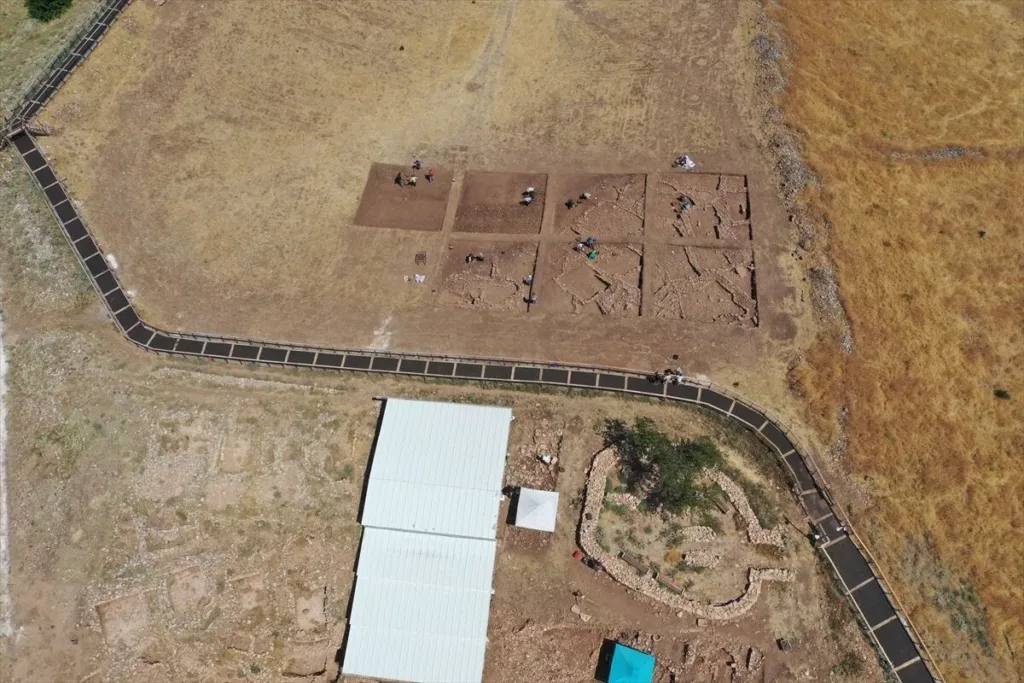
Göbekli Tepe's own sequence shows the shift internally: the large round enclosures belong to the earlier phase, and later construction on the mound is rectangular and smaller in scale, of a kind associated with houses.
The same trajectory shows up across the region. Gürcütepe, on the edge of Şanlıurfa, is a village of rammed-earth buildings with internal subdivisions alongside larger community buildings — and it is later than Göbekli Tepe. The world moved from communal monument to partitioned household.
Why the change probably happened
Farming. Over these centuries, plant and animal domestication took hold. That changes what a community is: fields have owners, herds have owners, stores have owners, and the household becomes the unit that matters.
The house replaces the enclosure. Rectangular buildings with divided interiors are architecture for property and privacy. Round communal structures are architecture for assembly. The shift in plan is a shift in social organisation.
The monuments may have stopped being necessary. One plausible reading is that the great enclosures were a technology for holding dispersed groups together — and once people were tied to fields and stores, that work was being done another way.
None of this is established causation. But the correlation between the end of monumental building and the rise of the farming household is close, and it is the mainstream reading.
The burial question is being rethought
The traditional account held that Göbekli Tepe's enclosures were deliberately backfilled — intentionally buried by their own builders, which is partly why they survived so well.
Lee Clare and the current excavation have complicated this. A substantial proportion of the fill is now attributed to slope collapse and displaced midden material moving downhill, possibly mixed with some deliberate backfilling.
That matters for this question. 'They buried their temples and left' is a dramatic ending. 'The buildings went out of use and the hillside gradually filled them' is a much more ordinary one — and closer to what the current reading supports.
The site was not sealed in a single ceremonial act of closure. It was abandoned and it silted up.
Was there a catastrophe?
No evidence supports one. There is no destruction layer, no mass grave, no sign of massacre, famine, plague or sudden flight.
The comet-impact and cataclysm claims attached to Göbekli Tepe — usually built on readings of Pillar 43 — are not supported by the excavation and are rejected by the archaeologists who work there.
What the evidence shows is gradual: buildings falling out of use, construction changing character, occupation continuing, the region remaining inhabited.
The genuinely interesting version
The end of Göbekli Tepe is not a mystery about disappearance. It is a question about why people stop doing something extraordinary.
For something like a thousand years, communities in these hills invested enormous collective labour in buildings that housed no one. Then, over generations, they stopped, and put that effort into houses, fields and herds instead.
That is a real historical transition and it happened to our ancestors, not to a vanished people. The mystery is not where they went. It is what changed about how they lived together — and the answer to that is still being worked out.
Common questions
What happened to the people of Göbekli Tepe?
They did not disappear. Over centuries they became farmers and villagers in the same landscape. The monumental tradition ended; the population continued.
When did Göbekli Tepe stop being used?
Monumental enclosure building had ceased by roughly 8000 BCE. Later construction on the mound is rectangular and smaller, of a kind associated with houses.
Was Göbekli Tepe deliberately buried?
This is being rethought. The current excavation attributes a substantial proportion of the fill to slope collapse and displaced midden material, possibly mixed with some deliberate backfilling — rather than a single act of ceremonial burial.
Was there a catastrophe or comet impact?
No evidence supports one. There is no destruction layer or mass grave, and cataclysm claims based on Pillar 43 are rejected by the archaeologists working at the site.
Why did they stop building the enclosures?
The most common reading links it to the rise of farming: as domestication took hold, the household became the organising unit, architecture shifted from communal round structures to partitioned rectangular houses, and the monuments may have stopped serving a needed function.
Where did they go?
Nowhere. Sites like Gürcütepe near Şanlıurfa show village life continuing in the same region after the monumental phase ended.
Sources & further reading5 references
- Clare, L. (2020). Göbekli Tepe, Turkey. A brief summary of research at a new World Heritage Site (2015–2019). e-Forschungsberichte des Deutschen Archäologischen Instituts 2020(2): 81–88.
- Schmidt, K. (2012). Göbekli Tepe: A Stone Age Sanctuary in South-Eastern Anatolia. Berlin: ex oriente. The foundational monograph by the site's first excavator.
- Dietrich, O., Heun, M., Notroff, J., Schmidt, K. & Zarnkow, M. (2012). The role of cult and feasting in the emergence of Neolithic communities. New evidence from Göbekli Tepe, south-eastern Turkey. Antiquity 86(333): 674–695.
- Notroff, J., Dietrich, O. & Schmidt, K. (2014). Building Monuments, Creating Communities. Early monumental architecture at Pre-Pottery Neolithic Göbekli Tepe. In J.F. Osborne (ed.), Approaching Monumentality in Archaeology: 83–105. Albany: SUNY Press.
- Hauptmann, H. (1993). Ein Kultgebäude in Nevalı Çori. In M. Frangipane et al. (eds), Between the Rivers and Over the Mountains: 37–69. Rome: Università di Roma «La Sapienza». The first report of a T-pillar cult building — the key precedent for Göbekli Tepe.
Full bibliography: the Taş Tepeler reference library →