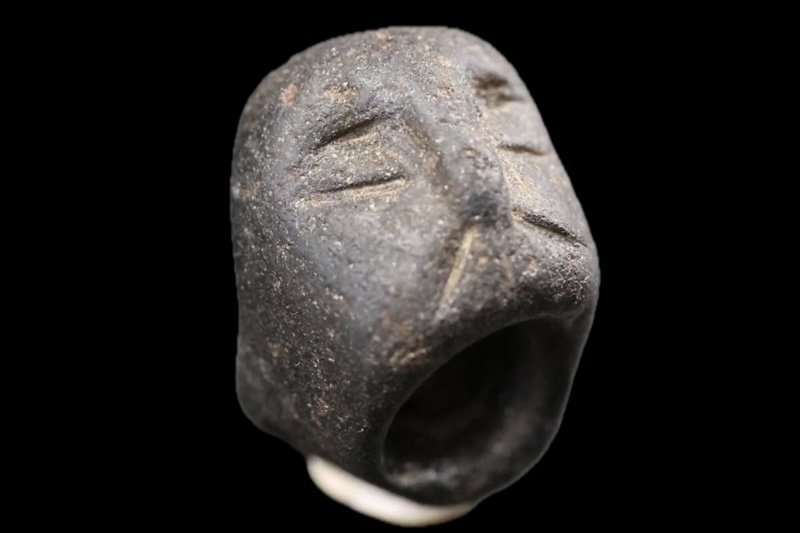
What was found
In the 2025 season at Sefertepe, the excavation led by Emre Güldoğan recovered a small, carefully worked bead carved with a double-faced human motif — two faces, one on each side of a single object. At only a few centimetres across, it is the kind of miniature carving that stands out even in a region famous for monumental stone. Türkiye Today, which photographed the piece during the season, describes it as a black basalt bead; Anatolian Archaeology reports the same, and notes a perforation marking it as a wearable ornament.
The find is reported from the field rather than set out in a peer-reviewed study, so its details are provisional. One point is genuinely unsettled: while most coverage calls the bead basalt, an Arkeonews report on the same announcement describes it as black serpentinite. Both are dark, dense, fine-grained stones easy to confuse by eye, and only laboratory study will settle which it is. We record both readings and flag the discrepancy rather than choose between them.
Beads as Sefertepe's signature
Beads are the most common category of find at Sefertepe, recovered from the first season onward in a wide range of forms and materials — including examples shaped like snake heads. Alongside the double-faced bead, the assemblage includes beads of jade, labradorite and limestone. Because jade and labradorite do not occur locally, the excavators read them as evidence that Sefertepe was tied into long-distance exchange or procurement networks rather than standing as an isolated village.
It is worth keeping this object separate from an earlier, different find. In 2024 the same excavation announced two jade ornaments — one depicting a leopard, the other a vulture with a human figure. Those are distinct pieces from a distinct season. The 2025 double-faced bead is its own object, defined by the two human faces worked on opposite sides.
Why it matters, and what's unknown
The interest of the bead is less its size than its ambition. Carving two recognisable human faces on opposite sides of a stone only centimetres across demands real control of the material, and it shows that the symbolic concerns visible on Sefertepe's carved blocks and pillars extended down to objects a person could wear or carry. Güldoğan's team present it as part of a picture in which symbolic expression ran across every scale of material culture at the site, from architecture to ornament.
What remains unknown is nearly everything a full study would establish: the bead's exact dimensions, its precise findspot within the settlement, a confirmed identification of the stone, and how it relates in time to the site's skull rooms and carved faces. Sefertepe is placed broadly in the Pre-Pottery Neolithic B, with the 2025 carvings reported as roughly 8,500 years old, but those figures come from press reporting rather than a published radiocarbon sequence.
Sources & further reading4 references
- Erdoğan, K. (2025). 8,500-year-old carved faces, tiny double-faced bead reshape Sefertepe's role in Taş Tepeler. Türkiye Today, 28 November 2025. Field reporting; awaiting full publication. link
- Altuntaş, L. (2025). At Sefertepe, tiny carvings and a 10,000-year-old skull room reveal an unexpected symbolic world. Anatolian Archaeology, 1 December 2025. Field reporting; awaiting full publication. link
- Kayra, O. (2025). A stunning Taş Tepeler discovery: human faces emerge from Sefertepe. Arkeonews, 26 November 2025. Field reporting; describes the double-sided bead as black serpentinite. link
- Altuntaş, L. (2025). An 8,500-year-old micro-carved bead and a 10,000-year-old skull room reveal Sefertepe's symbolic world. Arkeonews, 30 November 2025. link
Full bibliography: the Taş Tepeler reference library →