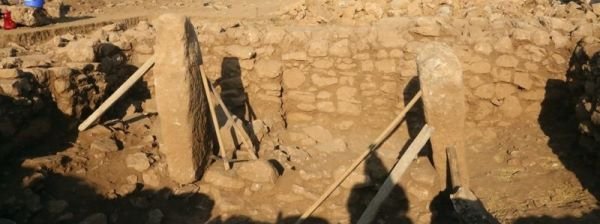
Rectangular architecture, not monumental
When the Şanlıurfa Museum ran a month-long salvage campaign at Harbetsuvan in 2017 — prompted by looting pits — excavators across three trenches exposed dry-stone rectangular buildings of limestone blocks, with standing stones set into the walls. Bahattin Çelik and Celal Uludağ, who published the season, describe at least one such building equipped with a pair of stone pillars at its centre, the arrangement that gives this page its name. They also recorded a built entrance into one room, a feature described as new for the Pre-Pottery Neolithic B in the region.
The scale is modest. The 2025 geophysical survey in Archaeological Prospection, reading the whole mound, mapped a dense cluster of small rectangular rooms with no monumental buildings anywhere on the site — the inverse of the pattern at the larger neighbours. So the T-pillar tradition is present here at village scale rather than in grand enclosures.
The seated male sculpture
The building's most striking find came from a wall in the southern trench: a seated male statue, about 70 cm as preserved, depicting a phallus. Çelik and Uludağ note that its closest counterparts are the seated male sculptures known from Karahan Tepe and Göbekli Tepe — the same visual tradition, at a smaller site. Other finds mix the ceremonial and the everyday: finger reliefs on a T-pillar left exposed by looters, an intact stone bench about 1.65 m long, Byblos-type arrowheads, obsidian, basalt pestles and dense flint scatter.
The statue is the site's strongest human-figure object, but its precise findspot, full context and catalogue data remain lightly published, and the comparison with the larger sites should stay at the level of shared tradition rather than direct equivalence.
Dating and caution
Harbetsuvan is placed in the Early Pre-Pottery Neolithic B, broadly contemporary with Göbekli Tepe's Level II — but that date rests on the resemblance of its architecture and finds to Göbekli Tepe rather than on a radiocarbon series from Harbetsuvan itself, so any claim that the site is older than Göbekli Tepe runs ahead of the evidence. No full site monograph yet exists, and the detailed plan, dimensions and stratigraphy of this building are still publication needs.
Sources & further reading3 references
- Çelik, B. (2016). A small-scale cult centre in Southeast Turkey: Harbetsuvan Tepesi. Documenta Praehistorica 43: 421–428. doi:10.4312/dp.43.21 link
- Uludağ, C. & Çelik, B.. Yeni Bir Çanak Çömleksiz Neolitik Dönem Kazısı: Harbetsuvan Tepesi. Türk Tarih Kurumu (Kazı Sonuçları). Primary report of the 2017 salvage excavation. link
- Archaeological Prospection (2025). The Layout and Size of an Early Pre-Pottery Neolithic B Small Settlement Revealed by Geophysical Prospection at Harbetsuvan Tepesi in Southeastern Anatolia. Archaeological Prospection. doi:10.1002/arp.70037 link
Full bibliography: the Taş Tepeler reference library →