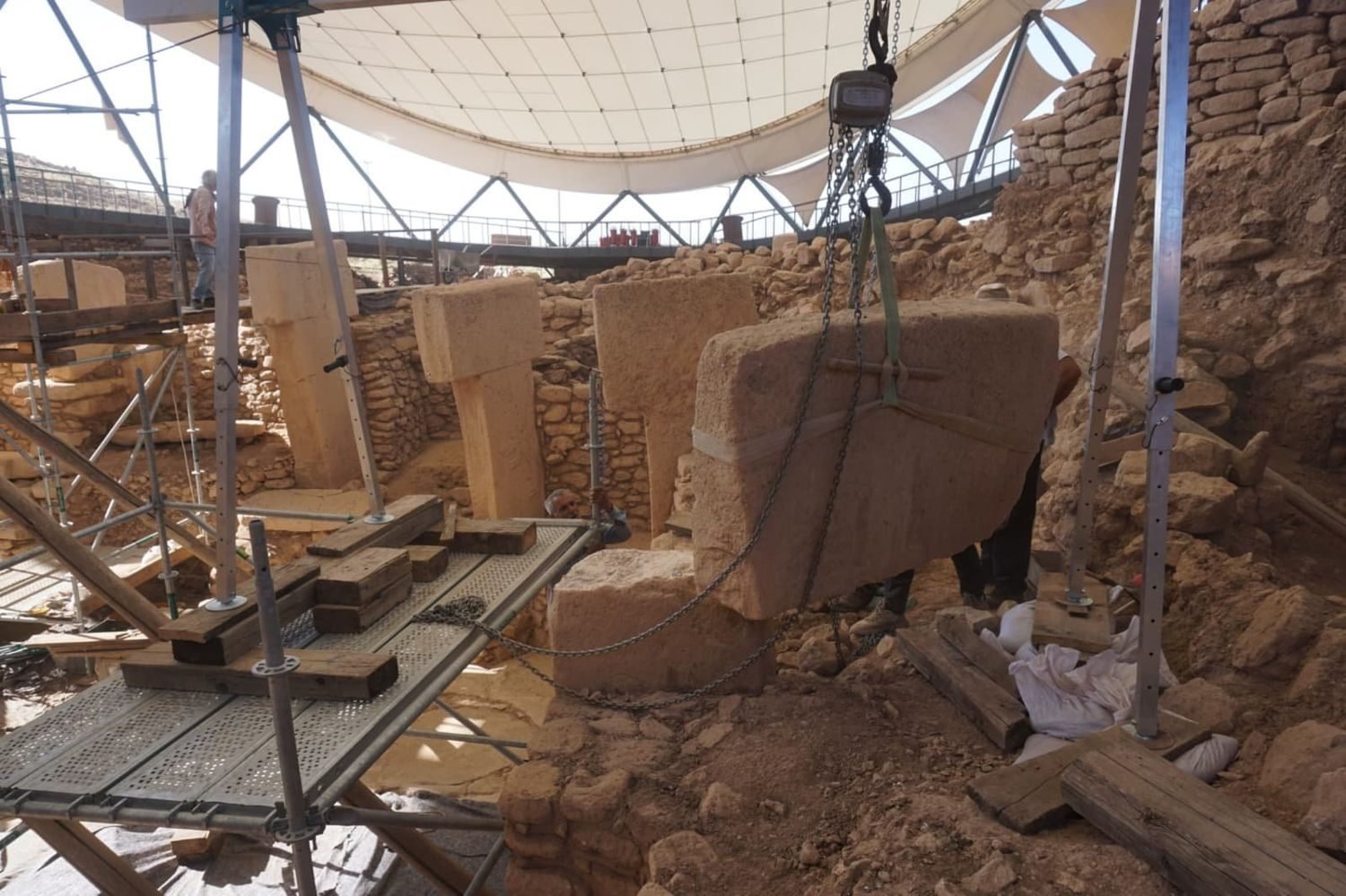
Fieldwork at Göbekli Tepe is ongoing and continuous. It is directed by Lee Clare (DAI) with Istanbul University, inside the Taş Tepeler research programme. Recent seasons emphasise conservation, the study of everyday and domestic life on the hill, and the opening of new areas — while geophysics shows that most of the site, perhaps fifteen to twenty enclosures, is still buried.
Digging that never stopped
Göbekli Tepe has been excavated every season since 1995, first under Klaus Schmidt and, since his death in 2014, under Lee Clare of the German Archaeological Institute with Istanbul University. That continuity matters: it means the site is documented to a depth few others match, with three decades of stratigraphy, finds, and radiocarbon dates tied to defined contexts.
Since 2021 the work has sat inside the wider Taş Tepeler programme, which coordinates research across Göbekli Tepe, Karahan Tepe, and a string of related sites in the Şanlıurfa region. Göbekli Tepe is no longer studied as a lone marvel but as one node in a landscape of early monumental building.
The map beneath the surface
One of the most important results of recent decades came not from digging but from geophysics. Ground-based survey has mapped the buried structure of the mound and suggests that fifteen to twenty large enclosures lie beneath the surface — the great majority of them never touched by a trowel.
That single fact reframes everything at the site. What visitors see is a small, carefully exposed sample. The current project treats those buried enclosures as a resource to protect, not a backlog to clear, leaving most of them in the ground for future methods to read.
A shift toward everyday life
The early years were about revelation — uncovering the enclosures and grasping their age. Recent fieldwork has turned toward a quieter question: did people simply gather here for ritual, or did they increasingly live on the hill? Attention has moved to grinding equipment, food processing, water management, and traces of domestic activity, all of which point to more sustained use than the 'empty temple' image once suggested.
This is a genuine change of emphasis rather than a new discovery of a single object. The team is re-reading the site as a place of both ceremony and ordinary life, and much of the argument now rests on the humble evidence of how people fed, watered, and organised themselves there.
Conservation on the same timetable
Every trench that is opened becomes something that has to be protected. Exposed limestone weathers quickly, so conservation runs on the same clock as excavation. The main enclosures sit under a permanent shelter opened in 2017, and stabilising the standing pillars is now part of routine fieldwork.
The 2026 season is a good example: conservators reinforced the great central pillars of Enclosure D against earthquakes, strapping and bracing individual stones under the canopy. Protecting what is already uncovered has become as central to a season's work as uncovering anything new.
What's settled and what's still moving
Settled: the excavation is ongoing, the site is far from fully dug, geophysics shows many more enclosures underground, and conservation is now inseparable from the digging. These points are not in dispute.
Still moving: how much of the hill was lived on versus visited, what the buried enclosures hold, and how the complex changed across its long life. These are live questions, and the current seasons are aimed squarely at them — which is why the picture of Göbekli Tepe keeps shifting.
Sources & further reading4 references
- Clare, L. (2020). Göbekli Tepe, Turkey. A brief summary of research at a new World Heritage Site (2015–2019). e-Forschungsberichte des Deutschen Archäologischen Instituts 2020(2): 81–88.
- Schmidt, K. (2012). Göbekli Tepe: A Stone Age Sanctuary in South-Eastern Anatolia. Berlin: ex oriente. The foundational monograph by the site's first excavator.
- Notroff, J., Dietrich, O. & Schmidt, K. (2014). Building Monuments, Creating Communities. Early monumental architecture at Pre-Pottery Neolithic Göbekli Tepe. In J.F. Osborne (ed.), Approaching Monumentality in Archaeology: 83–105. Albany: SUNY Press.
- The Tepe Telegrams (official research blog of the Göbekli Tepe Project, DAI). The Tepe Telegrams. Deutsches Archäologisches Institut. link Accessible, authoritative running commentary from the excavation team.
Full bibliography: the Taş Tepeler reference library →