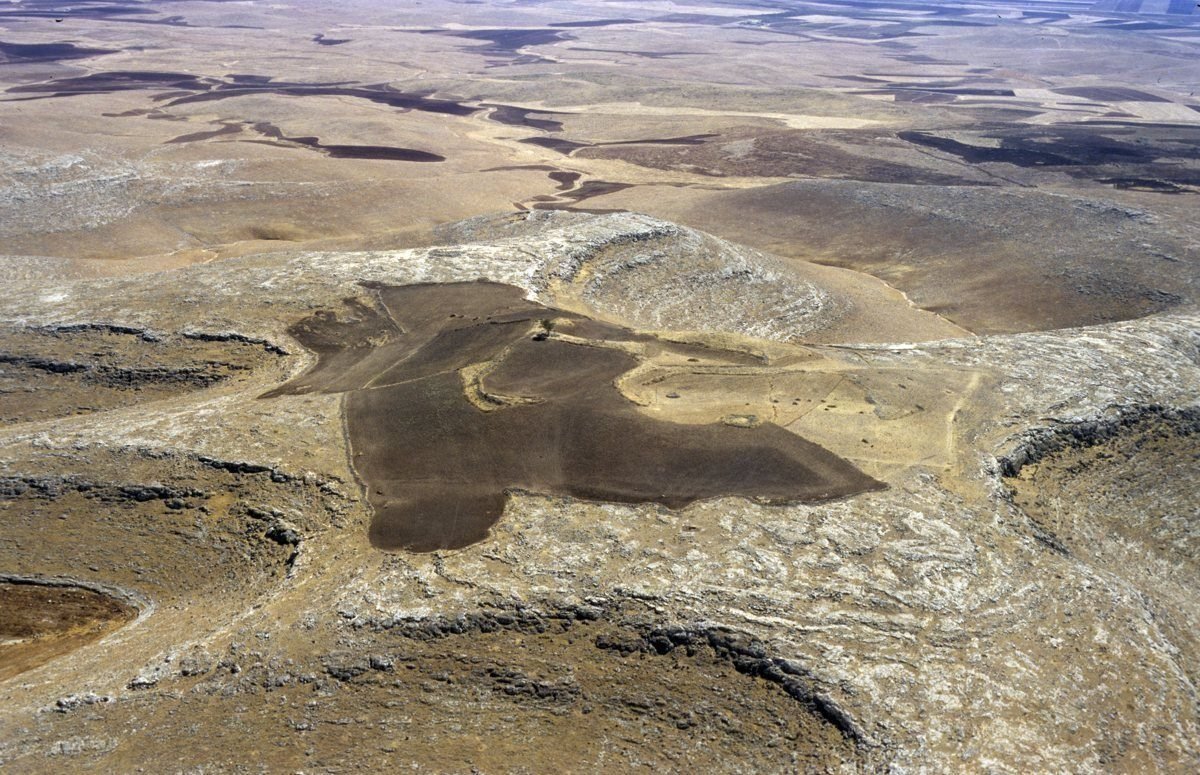
Göbekli Tepe sits on a dry limestone ridge with no spring on top. Yet people gathered here in numbers to build and, probably, to feast. Cut into the bedrock are basins and channels, and one leading interpretation is that they collected and stored rainwater. That reading fits the setting well — but whether every basin held water, or some served other purposes, is still debated.
A gathering place with no water
Any large gathering needs water. Raising multi-tonne pillars, feeding work crews, and hosting the feasts that seem to have drawn people to Göbekli Tepe all demand a reliable supply — and the summit offered none naturally. There is no spring on the hill.
That leaves two options: carry water up from the valley, which is heavy, constant work, or capture it on the spot. The evidence in the rock suggests people did the second — and the fact that they bothered says something about how much time they meant to spend there.
Cut into the rock
Across the plateau, the bedrock is worked with cut basins and linked channels. Some are shallow hollows; others are deeper, and grooves run between them in ways that look designed to move water rather than to occur by chance.
Reading these features is not simple. The same soft limestone was quarried for the pillars, cut for floors, and shaped for other purposes, so a hollow in the rock is not automatically a cistern. Distinguishing a deliberate water basin from a quarry scar or a worked floor is part of what makes this an active research question rather than a settled catalogue.
Rainwater harvesting — or something else?
The most discussed interpretation is straightforward: these basins and channels caught rainwater running off the bare rock and held it, an improvised harvesting system on a hill with no other supply. On a summit that receives seasonal rain but has no spring, that is a sensible thing to build.
But this is where honesty matters. Not every rock-cut feature need have held water, and their functions may have varied — storage, processing, or uses tied to building and ritual. The catchment reading is a strong, well-argued hypothesis rather than a proven fact, and careful accounts present it as one interpretation among possibilities still being weighed.
A clue to the bigger question
Water feeds directly into the largest debate about Göbekli Tepe: was it a place people visited for ceremonies, or somewhere they increasingly lived? Managing water on a waterless hill is the kind of investment you make when you intend to stay, or to return often and in numbers.
The cisterns don't settle that argument on their own. But taken with grinding equipment, food processing, and other traces of daily activity, they tilt the picture toward more sustained use, especially in the site's later phases — which is exactly the direction recent fieldwork has been pointing.
What's established, and what's debated
Established: there is no spring on the summit, and the bedrock carries cut basins and channels. Both are plainly visible in the record.
Debated: whether all of these features were made to hold water, how much they could store, and what that implies for how long people stayed on the hill. We present the cisterns as strong, suggestive evidence for deliberate water management — not as a closed case.
Sources & further reading3 references
- Clare, L. (2020). Göbekli Tepe, Turkey. A brief summary of research at a new World Heritage Site (2015–2019). e-Forschungsberichte des Deutschen Archäologischen Instituts 2020(2): 81–88.
- Schmidt, K. (2012). Göbekli Tepe: A Stone Age Sanctuary in South-Eastern Anatolia. Berlin: ex oriente. The foundational monograph by the site's first excavator.
- Dietrich, O., Heun, M., Notroff, J., Schmidt, K. & Zarnkow, M. (2012). The role of cult and feasting in the emergence of Neolithic communities. New evidence from Göbekli Tepe, south-eastern Turkey. Antiquity 86(333): 674–695.
Full bibliography: the Taş Tepeler reference library →