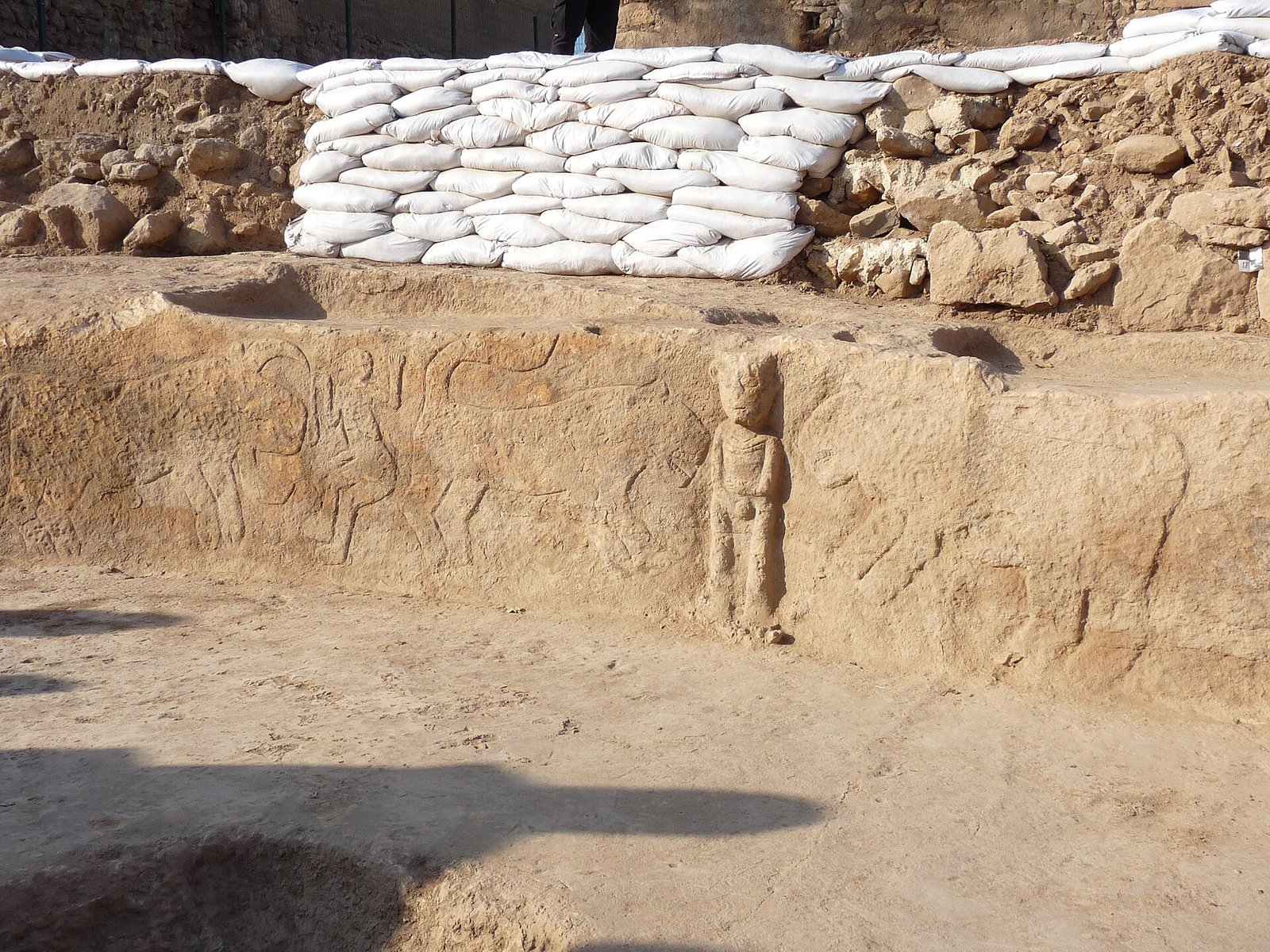
Two scenes, side by side
Read along the bench, the Sayburç relief shows two linked confrontations. In the first, a man — shown holding his phallus, a recurring Taş Tepeler motif of the male body — stands between two leopards that bare their teeth and claws toward him. In the second, a squatting human figure holds an object, variously read as a rattle or a snake, and faces a charging aurochs, a wild bull with huge curving horns.
One of the human figures is not flat relief but a three-dimensional sculpture emerging from the wall, which gives the whole composition a startling physical presence.
What it might mean
The recurring theme is humans face-to-face with the most dangerous animals of their world — big cats and wild cattle. Whether the scene depicts a myth, a heroic encounter, an ancestor story, or a ritual, we cannot say. What we can say is that it reads as action and confrontation, not static symbol — which is exactly why it is argued to be a narrative.
As with all Taş Tepeler imagery, the honest position is that we see the scene clearly and cannot fully read it.
The oldest 'scene' we know
Published by Eylem Özdoğan in 2022, the Sayburç bench relief is argued to be the earliest known narrative scene in art — not a set of separate symbols, but figures that relate to one another as if in a single event. On one side a man grips his phallus while two leopards flank him, teeth and claws bared; beside him a squatting figure holds a rattle or snake and faces a charging aurochs, its horns lowered.
The claim to watch is the word 'narrative.' Whether these figures tell one connected story or are two linked but separate images is debated. But the arrangement — figures turned toward each other, action implied — is a real shift from the isolated animals of earlier walls toward something like storytelling in stone.
Common questions
What does the Sayburç relief show?
Two linked scenes: a man flanked by two leopards, and a squatting figure with a rattle or snake facing a charging aurochs. One human figure is carved in three dimensions.
What does the Sayburç relief mean?
It appears to show humans confronting dangerous animals — possibly a myth or story — but its specific meaning is unknown. Its importance is that it reads as a connected scene, not isolated symbols.
Sources & further reading2 references
- Özdoğan, E. (2022). The Sayburç reliefs: a narrative scene from the Neolithic. Antiquity 96(390): 1599–1605. doi:10.15184/aqy.2022.125
- Karul, N. (2021). Buried Buildings at Pre-Pottery Neolithic Karahantepe. Türk Arkeoloji ve Etnografya Dergisi 82: 19–29.
Full bibliography: the Taş Tepeler reference library →