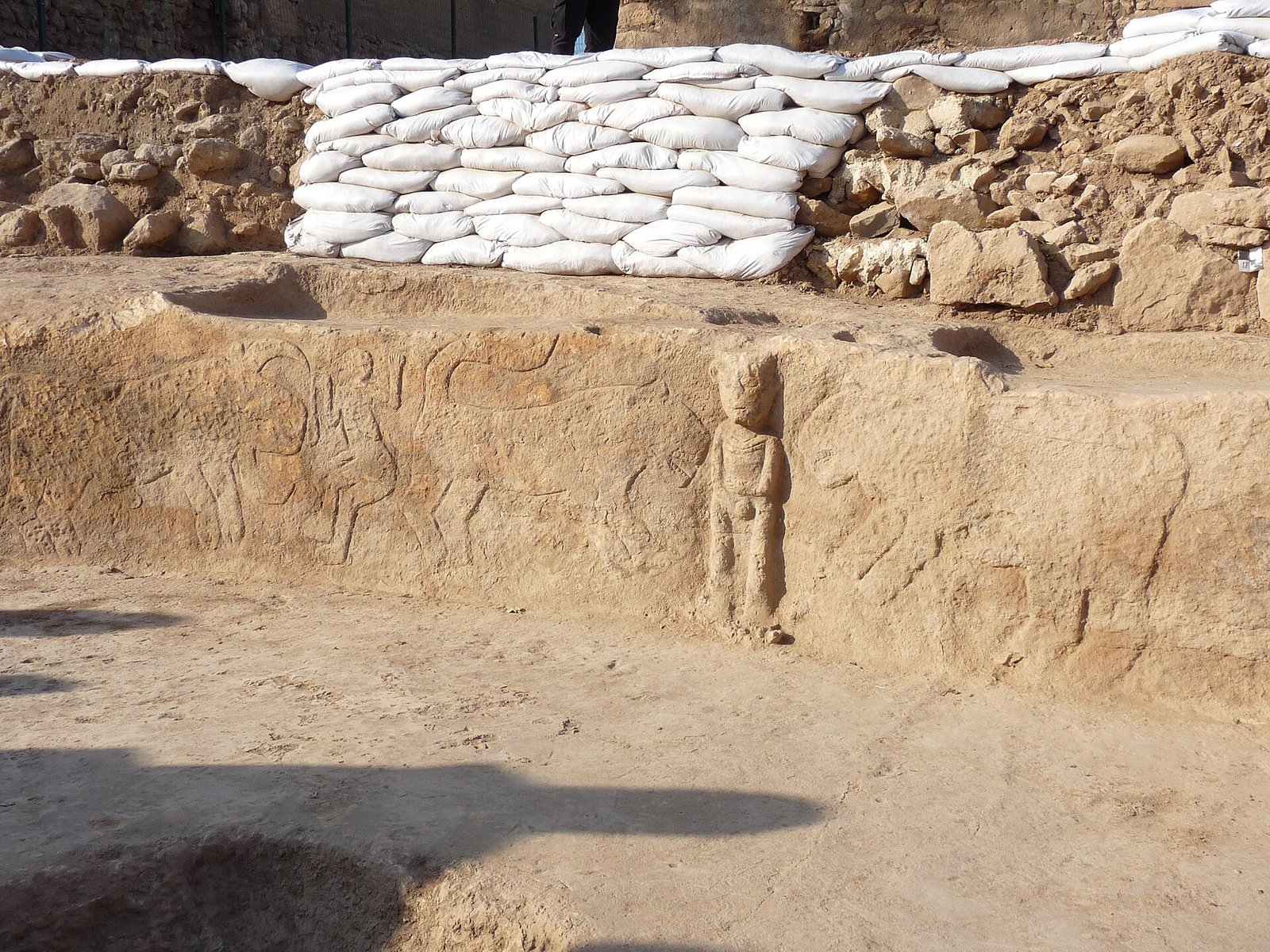
Leopards and an aurochs
The animals on the Sayburç relief are, characteristically for this world, the dangerous ones. Two leopards flank the central male figure, teeth and claws bared. Facing the second human figure is an aurochs — a wild bull, the huge and formidable ancestor of domestic cattle, shown charging with great curving horns.
The object held by the squatting figure is debated: some read it as a rattle, others as a snake, which would add a third dangerous creature to the scene.
The dangerous-animal theme
This choice is not incidental. Across Taş Tepeler — on the pillars of Göbekli Tepe, in the predator bones of Karahan — the animals that mattered were overwhelmingly the ones with the power to kill: leopards, aurochs, snakes, vultures. The Sayburç relief takes that same charged bestiary and, uniquely, arranges it into a scene of confrontation with human beings.
Why leopards, and why confronting a man
The animals are specific and deliberate: two leopards flanking a human, and a charging aurochs (wild cattle) facing a second figure. These are the region's most dangerous animals — exactly the powerful, threatening creatures the Taş Tepeler carvers favoured over the gazelle they actually ate.
The distinctive thing at Sayburç is the confrontation. Elsewhere animals are carved alone or in rows; here they face humans in postures of threat and encounter. It reads as a moment of danger or mastery — a person between predators, a person before a charging bull. Whether it depicts a myth, a hunt, an ordeal or an ancestor story, we can't say. What's clear is that it stages humans and dangerous animals in direct relationship, which is rare and early.
Common questions
What animals are on the Sayburç relief?
Two leopards flanking a male figure, and a charging aurochs (wild bull) facing a second figure. The object one figure holds may be a snake or a rattle.
Why are they dangerous animals?
Like the rest of Taş Tepeler art, the relief favours powerful, dangerous creatures — leopards and wild cattle — rather than everyday prey, part of the region's charged animal symbolism.
Sources & further reading2 references
- Özdoğan, E. (2022). The Sayburç reliefs: a narrative scene from the Neolithic. Antiquity 96(390): 1599–1605. doi:10.15184/aqy.2022.125
- Karul, N. (2021). Buried Buildings at Pre-Pottery Neolithic Karahantepe. Türk Arkeoloji ve Etnografya Dergisi 82: 19–29.
Full bibliography: the Taş Tepeler reference library →