Short answer
No published evidence shows Çakmaktepe is older than Göbekli Tepe. Çakmaktepe has produced early-looking material and is sometimes called one of the region's earliest sites, but its radiocarbon chronology has not been published — so a clean 'older-or-younger' ranking against Göbekli Tepe cannot yet be made.
Both sit in the same early Pre-Pottery Neolithic horizon in the same corner of Şanlıurfa. Göbekli Tepe has the largest published radiocarbon series in the region; Çakmaktepe has far less excavation and no comparable published sequence. Until that sequence exists, 'older' is a claim the evidence can neither support nor rule out.
The short version
Çakmaktepe is often described as holding some of the earliest Neolithic ground in the Taş Tepeler landscape, which naturally raises the question of whether it beats Göbekli Tepe. It can't be answered cleanly yet. Çakmaktepe is far less excavated and published than Göbekli Tepe, and its detailed radiocarbon chronology has not appeared in print.
Both sites sit within the same early Pre-Pottery Neolithic horizon in the same region. Some of Çakmaktepe's ground shows very early activity — bedrock-cut houses, grinding stones, animal-head deposits — but a firm, published sequence placing it before or after Göbekli's great enclosures is not yet in hand. 'Appears to be early' is doing real work in every version of the claim.
What dating actually exists at Çakmaktepe
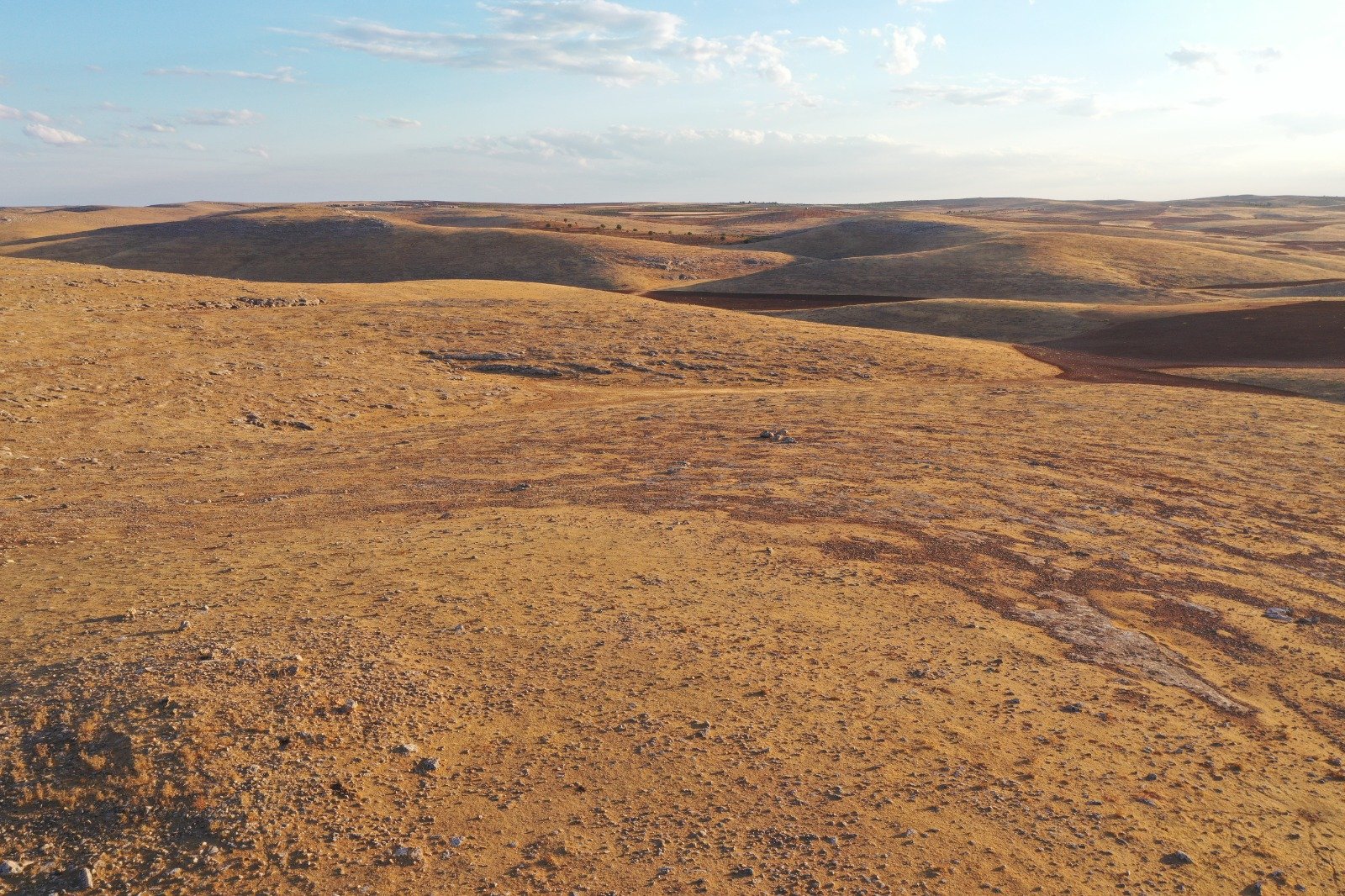
The 'older' claim rests less on absolute dates than on the character of the material. Çakmaktepe has open-air, bedrock-cut features, grinding stones and mortars, and deliberate animal-head deposits — an assemblage read as belonging early in the local Neolithic.
What it does not yet have in print is a published series of calibrated radiocarbon dates tied to a stratigraphic sequence, of the kind that anchors Göbekli Tepe's chronology. Excavation is recent and ongoing; season reports describe the finds, but the formal dating framework — lab codes, sample contexts, calibrated ranges — has not been released. Any age comparison therefore rests on typology and impression, not on measured dates set side by side.
Where the 'older than Göbekli Tepe' idea comes from
Two things drive it. First, Çakmaktepe looks archaic: its round, bedrock-cut houses and open-air layout resemble the earliest, pre-monumental end of the regional sequence rather than the great enclosures. Second, 'older than Göbekli Tepe' is an irresistible headline — it is the benchmark every new Şanlıurfa site gets measured against, and the phrase travels well.
Neither the look of a site nor a good headline is a date. Sites can share an early style without being strictly earlier, and typology alone cannot separate a few centuries — which is exactly the margin the question turns on.
Why 'oldest' is the wrong contest
Chasing a single 'oldest site' also misses what the evidence is good for. Taş Tepeler is best understood as a connected world of communities inventing monumental life together across several centuries — some sites preserving early ground, others reaching a monumental peak.
Even if Çakmaktepe's dates eventually land a little earlier, that would make it an early member of one network, not the origin point from which everything else descends. The interesting question is not which hill was first, but how the whole landscape changed together.
What would settle it
The question is answerable, and the method is standard. A published series of calibrated radiocarbon dates from secure, stratified contexts at Çakmaktepe — charcoal or bone tied to specific building phases — could be set directly against Göbekli Tepe's series.
If Çakmaktepe's ranges fell clearly earlier, 'older' would be earned. If they overlap, the honest verdict is 'contemporary, within error' — and overlap is the likeliest outcome, because the two sites sit so close together in the same early horizon. Until those dates are in print, the accurate answer is: not established.
Common questions
Is Çakmaktepe older than Göbekli Tepe?
Not on the published evidence. Çakmaktepe may hold some of the earliest ground in the region, but its dating has not been published and it is far less excavated, so it can't be cleanly ranked as older or younger than Göbekli Tepe.
Has Çakmaktepe been radiocarbon dated?
Not in a published sequence. Season reports describe early-looking finds — bedrock-cut houses, grinding stones, animal-head deposits — but a formal series of calibrated dates tied to stratigraphy, of the kind that anchors Göbekli Tepe, has not yet appeared.
Why do people say it might be older?
Because its open-air, bedrock-cut architecture looks archaic, and because 'older than Göbekli Tepe' is the headline every new Şanlıurfa site gets measured against. A site's style and a catchy phrase are not the same as measured dates.
Sources & further reading3 references
- Schmidt, K. (2012). Göbekli Tepe: A Stone Age Sanctuary in South-Eastern Anatolia. Berlin: ex oriente. The foundational monograph by the site's first excavator.
- Clare, L. (2020). Göbekli Tepe, Turkey. A brief summary of research at a new World Heritage Site (2015–2019). e-Forschungsberichte des Deutschen Archäologischen Instituts 2020(2): 81–88.
- Karul, N. (2021). Buried Buildings at Pre-Pottery Neolithic Karahantepe. Türk Arkeoloji ve Etnografya Dergisi 82: 19–29. link
Full bibliography: the Taş Tepeler reference library →