Short answer
Göbekli Tepe is far older than Stonehenge — by more than six thousand years. Its stone rings went up around 9500 BCE, built by hunter-gatherers; Stonehenge was raised around 3000–2500 BCE by settled farmers.
Both set large upright stones in circles, which is why they invite comparison, but the cultures are unrelated and the gap is enormous. Göbekli Tepe predates farming, pottery and metal in its region; Stonehenge came thousands of years after all three.
The headline: six thousand years apart
In one line: Göbekli Tepe is far older than Stonehenge — by more than six thousand years. Stonehenge was built by settled farmers around 3000–2500 BCE. Göbekli Tepe's rings went up around 9500 BCE, raised by hunter-gatherers who had no farms, no pottery and no metal.
To feel the scale of that gap: the distance in time between Göbekli Tepe and Stonehenge is larger than the distance between Stonehenge and us. When the first sarsens were dragged across Salisbury Plain, Göbekli Tepe had already been buried and forgotten for millennia.
What is actually at each site
Stonehenge's great stones were raised in stages, mostly between about 3000 and 2500 BCE, by farming communities using antler picks and, later, bronze tools. Its sarsens are largely undecorated, capped with lintels to form the famous trilithons — an open-air ring on a chalk plain.
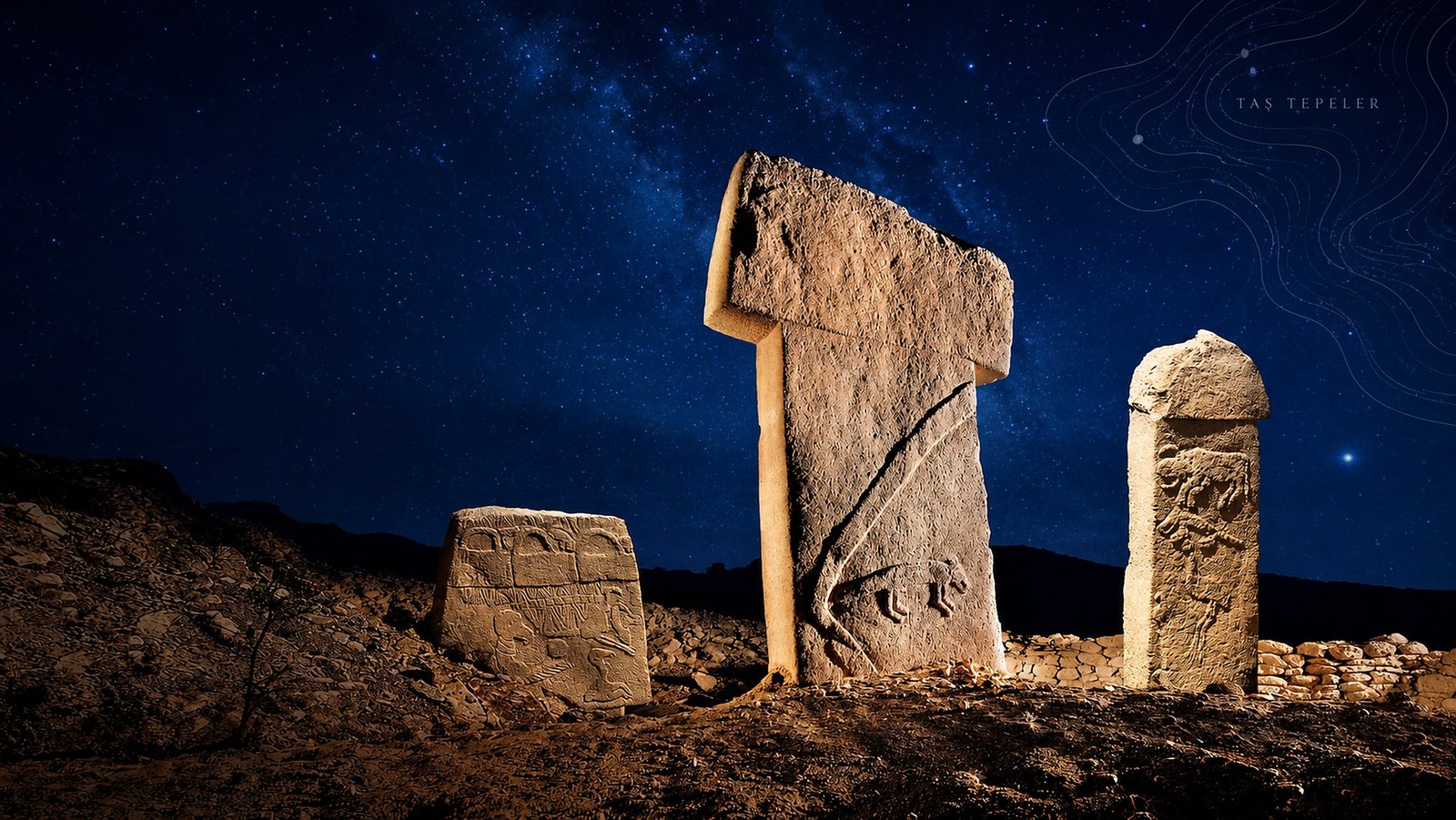
Göbekli Tepe's enclosures date to roughly 9500–8000 BCE, in the Pre-Pottery Neolithic, and were built with stone tools alone. Its uprights are T-shaped pillars carved as human figures, crowded with reliefs of foxes, snakes, boar and vultures, and — on the current reading — set inside walled, probably roofed buildings rather than standing free under the sky.
How we know the two ages
The six-thousand-year gap is not guesswork; both dates rest on radiocarbon, but on different-quality evidence. Göbekli Tepe's key date comes from organic material in the loam wall plaster of Enclosure D, which places its construction firmly in the Pre-Pottery Neolithic A, around 9500 BCE — a date on the building itself, backed by charcoal near bedrock. Stonehenge is dated from antler picks, cremated bone and material in its dug features, building a well-resolved sequence of stages between roughly 3000 and 1500 BCE, with the great sarsen setting around 2500 BCE.
So both ages are secure, but they answer slightly different questions. Stonehenge's dating tracks a monument rebuilt again and again over some fifteen centuries. Göbekli Tepe's anchors the moment its most famous enclosure went up. Either way the order is not in doubt: Göbekli Tepe is older, by a margin larger than all of recorded history.
The effort each one demanded
The engineering invites comparison too, and here Stonehenge is the more extreme feat of transport. Its bluestones were carried some 200 km from the Preseli hills of Wales; its sarsens, weighing up to 25 tonnes, were dragged around 25 km and then dressed and capped with carefully jointed lintels — mortice-and-tenon and tongue-and-groove joints borrowed from carpentry.
Göbekli Tepe's pillars are lighter (up to about ten tonnes) and were quarried a short walk away, not hauled across a country. Its astonishment lies elsewhere: the builders had no farming, no pottery, no metal and no draft animals, and still carved those pillars into human figures covered in relief. Stonehenge is the greater logistical achievement; Göbekli Tepe is the more improbable one, because of who built it and when.
What each one was for
Purpose is where both sites keep their secrets, and it is worth being honest that neither is 'solved.' Stonehenge sits in a vast ceremonial landscape of burial mounds and avenues; it shows clear solar alignments to the midsummer and midwinter sun, and it served, among other things, as a place for the dead — cremated human remains were buried there in quantity. Beyond that, its full meaning is still debated.
Göbekli Tepe shows no comparable, demonstrated astronomical alignment. Its enclosures are read instead as places of gathering, feasting and shared belief, bound up with the human figure and a striking preoccupation with animals and the dead. Both, in other words, were about bringing people together around something larger than survival — but the specifics were their own, and claims that either encodes a star map or a secret calendar go well beyond the evidence.
Same broad idea, unrelated cultures
Both sites do something similar: they gather large upright stones into rings that clearly mattered enormously to the people who raised them, at a cost far beyond daily need. The resemblance is real, and it is why the two are forever paired in headlines.
But there is no line connecting them. Six thousand years and some three thousand kilometres separate Göbekli Tepe from Stonehenge, with no cultural continuity between the Neolithic foragers of the Şanlıurfa hills and the Bronze-Age-cusp farmers of southern Britain. They arrived at the idea of monumental stone circles independently.
Why the comparison is worth making
The point of holding them side by side is not to declare a winner. It is that Stonehenge is the monument most people already carry in their heads — the yardstick for 'impossibly old and mysterious.'
Set Göbekli Tepe against it and the yardstick breaks. The instinct is to assume the older site must be cruder, simpler, a first rough draft. Instead the older site is the more surprising one: elaborately carved, and built by people who had not yet settled down. Stonehenge is the famous stone circle; Göbekli Tepe is the one that resets the clock.
What they honestly don't share
It is worth being clear about the limits of the comparison, because it is often overstretched. The two were built by unrelated cultures for their own purposes, and neither 'explains' the other.
Stonehenge shows clear solar alignments and belongs to a landscape of burial mounds and farming; its purpose debate is its own. Göbekli Tepe's purpose — gathering, feasting, shared belief — is argued on its own evidence. And popular claims that tie the two into a single lost tradition, or read either as a star map or a coded calendar, are not supported. The honest link between them is simple and still striking: two peoples, far apart in time and place, both chose to raise rings of great stones.
Göbekli Tepe and Stonehenge, side by side
Common questions
How much older is Göbekli Tepe than Stonehenge?
More than six thousand years. Göbekli Tepe's rings date to around 9500 BCE; Stonehenge's main stones to around 3000–2500 BCE.
Are Göbekli Tepe and Stonehenge connected?
No. They were built by unrelated cultures thousands of years and thousands of kilometres apart. Both raise large stones in rings, but there is no cultural link between them.
Which is more impressive?
They are hard to rank. Stonehenge is more famous and precisely engineered with lintels; Göbekli Tepe is far older and elaborately carved, and was built before farming — which is what makes it so surprising.
Sources & further reading4 references
- Schmidt, K. (2012). Göbekli Tepe: A Stone Age Sanctuary in South-Eastern Anatolia. Berlin: ex oriente. The foundational monograph by the site's first excavator.
- Clare, L. (2020). Göbekli Tepe, Turkey. A brief summary of research at a new World Heritage Site (2015–2019). e-Forschungsberichte des Deutschen Archäologischen Instituts 2020(2): 81–88.
- Notroff, J., Dietrich, O. & Schmidt, K. (2014). Building Monuments, Creating Communities. Early monumental architecture at Pre-Pottery Neolithic Göbekli Tepe. In J.F. Osborne (ed.), Approaching Monumentality in Archaeology: 83–105. Albany: SUNY Press.
- Haklay, G. & Gopher, A. (2020). Geometry and Architectural Planning at Göbekli Tepe, Turkey. Cambridge Archaeological Journal 30(2): 343–357.
Full bibliography: the Taş Tepeler reference library →